Pre-Conference Institutes
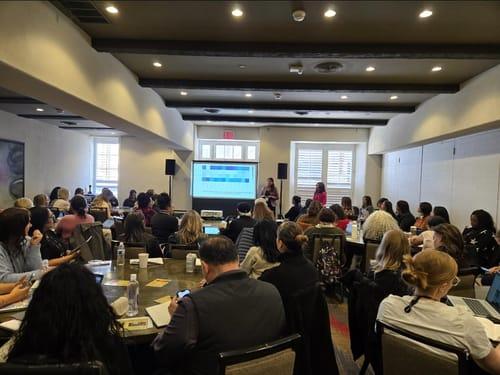
La Cosecha Pre-Conference Institutes respond to specific topics and needs of dual language education classrooms and programs. These intensive institutes permit time for professional engagement and exploration of a particular topic/need. These institutes will take place in-person ONLY, and due to the level of interaction in each institute, space is limited.
Pre-conference institute fees are IN ADDITION to the regular La Cosecha conference registration. If you are registered and want to add to your registration email lcreg@dlenm.org.
You can also register for a Pre-Conference Institute as a stand-alone event. Click below to register now!
Tuesday, November 10 - Wednesday, November 11, 2026 – $449
Key Strategies for Biliteracy – Project GLAD® Institute
Are you GLAD trained or new to GLAD? This pre-conference institute integrates a biliteracy focus with innovative Project GLAD®strategies to leverage students’ bilingualism and build academic content and language proficiency in English and Spanish. Experience GLAD®strategies through a dual language lens and plan for implementation in your school setting. You’ll leave equipped with practical strategies to elevate your biliteracy teaching practices. This workshop will be led by OCDE Project GLAD®experts in bilingualism and biliteracy.
DLeNM GLAD® Biliteracy Team
Wednesday, November 11, 2026 – $215
Dual Language Education Foundations
for State, District, and School Leadership
Are you a leader in a new or established dual language program? This one-day institute will focus on practical leadership in effective program design and implementation practices grounded in strong research and policies. Participants will identify problems of practice and choose from sessions led by dynamic experts and seasoned state, district, and school leaders. Sessions include topics such as biliteracy instruction, classroom walkthroughs, secondary scheduling and planning, student engagement, serving dually identified students, and teacher preparation and development. Join us to collaborate and engage with colleagues, learn from successful leaders, and take your program to the next level!
Sponsored by NAELPA and DLeNM with Mario Palma, Yvonne Williams, Mishelle Jurado, Joan LaChance, and school and district leaders from Atlanta, GA, Salem-Keizer, OR, Mount Vernon and Sunnyside, WA
Educating English Learners for a Transformed World: Designing Systems That Deliver for Multilingual Learners
Is the difficulty related to language learning or a learning disability? Explore a strengths-based MTSS approach for distinguishing language-learning challenges from potential disabilities. Through a collaborative case study, participants will examine intensive instruction, intervention, and ongoing assessment while building on students’ bilingualism, cultures, experiences, and interests. Leave with research, practical resources, and a guiding framework to support multilingual learners.
Joan Lachance, Wayne Thomas, Virginia Collier, and the DLeNM DLBE Team
Culturally and Linguistically Responsive MTSS: Tier 1+ Critical Factors to Examine for Multilingual Learners Experiencing Challenges in a Dual Language Program
In this session, participants will explore critical factors to consider during Tier 1+ and Tier 2 through a collaborative case study example. Participants will take an in depth look into each of the critical factors and discuss strategies and resources to support each factor for MLs experiencing challenges: the learning environment, academic performance and instruction, oral language development, literacy/ biliteracy development, cross cultural considerations, physical and psychological considerations, previous schooling, and family and personal considerations. Participants will receive templates, tools, resources and research to support each of the critical factors and examples of structures and frameworks districts have used to incorporate the critical factors into their comprehensive culturally and linguistically responsive and sustaining MTSS process.
Cristina Sánchez-López
Paridad Education Consulting
Teaching for Biliteracy in Action
The Teaching for Biliteracy team will provide an interactive overview of the instructional and programmatic elements of teaching for biliteracy within a variety of models, 90/10, 80/20, 50/50, 2-way immersion, and 1-way immersion, and in one-teacher (self-contained) and two-teacher (partnering) configurations. Participants will define biliteracy, learn about the multilingual perspective and experience elements of a biliteracy unit framework: oracy, background knowledge and language comprehension, evidence-based reading and writing instruction, content instruction, and the Bridge for transfer and contrastive analysis to develop metalinguistic awareness. Participants will also receive digital access to year-long biliteracy maps and units.
Karen Beeman, Melody Wharton, Crystal Ramos
Center for Teaching for Biliteracy
Santa Fe Community Convention Center and Hotel Partners
Questions? We're happy to help!